One Hit Oneidas
Sects Without Reproduction

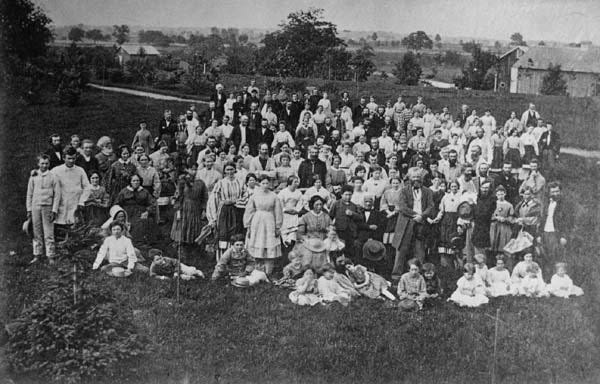
My recent interest in colorful cults and religious sects from America’s past stems in part from my desire to mimic their example in stitching strangers together into a cohesive, if not always coherent, whole. Even if the flavor of their Kool-Aid isn’t to our liking, we atomized moderns have a lot to learn from anyone who conjured bustling, thriving communities out of religious and cultural chaos. The lessons from erstwhile American prophets may fall heavily in the “what not to do” camp, as we saw in the tragicomic life of Joseph Smith, but we who live in not-so-splendid isolation in our glass McMansions shouldn’t be so quick to throw stones. The most delusional utopian schemer who set about the work of pouring the foundations for his castle in the air has more to teach us about building community than any armchair-riding influencer.
This is as true for the failures as for the runaway successes like Smith. While the Perfectionists of Oneida, NY, close contemporaries of the early Mormons and fellow pioneers in religious innovation, have faded from public consciousness, they burned with enough intensity to project some light onto our current clouded social landscape. Like the one hit wonder rock bands mythologized by Tom Hanks in his 90s cult classic That Thing You Do, they exploded from obscurity to capture the American zeitgeist, even if they couldn’t hold onto it for long.
That Thing You Do’s fictional meta-band, borrowing from Beatles spelling book to call themselves The Oneders (pronounced Wonders by fans, and O’Needers by the uninitiated), set the charts on fire with their hit song (guess the title) only to fizzle out due to internal drama and creative stagnation. I don’t think the Perfectionists intended the same pronunciation for their Oneida community, but they charted a similarly brief and bright trajectory.

The Perfectionists’ frontman John Humphrey Noyes wouldn’t be anyone’s idea of a rock star (Joseph Smith or Brigham Young on the other hand…). Though he shared the millenarian outlook of Smith and other 19th century prophets, devoting his life to bringing about a kingdom of heaven on earth, in personality he resembled less the archetype of the charismatic circuit riding preacher than the socially autistic tech founder spoofed by the show Silicon Valley. He was as smitten with building a spiritually perfect society on earth as Elon Musk is with colonizing Mars; and he was just as willing to deviate from norms around relationships with women. And he was not without swagger: on the eve of starting his cult, he declared himself spiritually perfect and beyond the reach of old moral laws.
Other than such pronouncements, what made the Perfectionists notorious in their own day and fascinating in ours was Noyes’ establishment of what he called “complex marriage,” sort of an institutionalized form of swinging. Instead of pairing up, men and women at his Oneida community were to be conjugal with all adult community members of the opposite sex. It was even weirder than it sounds. Presaging Musk’s unusual arrangements with his legion of girlboss baby mamas (most of whom he supposedly impregnated remotely via IVF), Noyes’ concept was not an orgiastic free-for-all but something more clinical, in this case designed to break the inward, atomizing tendencies of nuclear family bonds. This nuclear family fission would free up all that social energy to bind the community together in a communal bond as intense as that holding together man and wife. It was the Biblical “one flesh” doctrine of marriage stretched, Buffalo Bill style, to encompass the whole neighborhood.
Setting a battering ram to any barriers to communal intimacy, the Perfectionists also practiced what they called “mutual criticism.” On a regular basis, each member of the community would take their turn in a hot seat in front of a panel of their peers for a Festivus-style airing of grievances. Personal hygiene, fashion faux pas, bedroom issues, annoying verbal tics: all of it was fair game. In theory, this process worked like a steam iron to smooth out any social wrinkles before they hardened into division. Along with other oddities, like “male continence,” Noyes’ pioneering approach to birth control, mutual criticism and complex marriage helped Noyes to transform a diverse group of unaffiliated seekers into a gelatinous communal blob.

The Oneida held together according to Noyes’ principles for three decades, quite an impressive feat when most modern attempts at communal zones, like Seattle anarchists’ CHOP commune in 2020, combust instantaneously. Their relative endurance is even more remarkable given their surroundings. As the example of the Mormons attests, 19th century Americans did not have a lot of patience for weird religions in their midst, especially not when sexual shenanigans were involved. Yet the Perfectionists managed to stay in one spot for years, openly living their principles less than a hundred miles away from where Smith unearthed his golden plates.
A big part of that resilience was that they appeared less threatening. They were not uber-proselytizers nor were they given to thunderous revelations and proclamations of their eventual rule, both Mormon qualities that caused them endless problems with their neighbors. This was helped by their academically-minded founder’s preference for sociological experimentation over empire-building. If Joseph Smith was a 19th century Ayatollah Khomeini, vying for spiritual and political control of his surroundings, Noyes was more of a spiritualist hybrid of Alfred Kinsey and Hugh Hefner, with his academic credentials and publishing pretensions granting him secular footing and more public leeway for sexual deviance.
While the Perfectionists’ experimental vibe had the short-term advantage of keeping the torches and pitchforks at bay, their lack of martial vigor ultimately provoked their demise. When Noyes’ sexual hijinks resulted in a warrant for statutory rape in his old age, he fled for Canada and bid his followers give up on complex marriage. This was a far cry from Joseph Smith’s approach to external pressures, which was almost universally to choose deception, open battle or mass exodus over submission (only after Mormonism was fully established did it yield to its neighbors demands to ban polygamy).
Noyes’ conflict-aversion also hindered any chance of leadership succession. This was not a problem for the virile Smith, who attracted like-minded men and leadership candidates by the score, including not just the Octavian figure of Brigham Young but men like James Strang, who recreated Smith’s prophetic journey in miniature before being assassinated in his own religious kingdom on Beaver Island in Michigan. In contrast, Noyes seemed to attract industrious neurotics like himself, none of whom were willing to carry the torch after their illustrious leader bravely turned his tail and fled.
We can be grateful that the Oneida sociological experiment ended with Noyes (the business side of the enterprise persisted and still continues today). The only people interested in replicating complex marriage would be today’s polyamorists and we’ve already seen more than enough of mutual criticism in corporate-mandated DEI struggle sessions. But is there anything we can glean from the Perfectionists’ momentary success in holding together a community?
Like the celibate Shakers and the polygamous Mormons, the polyamorous Perfectionists recognized a fundamental opposition between the inward focus of the nuclear family and outward generosity required to develop a community. As the demands of their communities were so intense, they developed a commensurate antagonism towards the monogamous marriage bond. Splitting the nuclear bond freed up enormous social energies for their leaders to command on behalf of the group, though often to self-destructive ends.
Those of us seeking to build Christian communities out of our atomized landscape of Pottervilles are also looking for an outward-directed social energy to forge connections that reach from kin to kith. But we don’t need to break the nuclear bonds between spouses and parents and children to get it. Such huge energy demands are only necessary to bind initiates to outlandish cults. But building back a bastion of healthy American normalcy like Bedford Falls requires only a fraction of that social power.

For such a goal, the nuclear family bond is not a fuel source but the essential building block. Once again, It’s a Wonderful Life shows the blueprint. The Baileys are in the same community building business as the Perfectionists. Indeed, Mr. Potter calls them everything but a cult, deriding Peter Bailey as “starry-eyed dreamer” who stirs up the rabble with “a lot of impossible ideas.” But the Baileys’ formula for the greater good is just weapons-grade normalcy. They build single family homes for working-class families and then knit them together into a broader community. Their own family furnishes the model home, George and Mary working together to transform the ruined Granville house from a blight on the neighborhood into a beacon of hope.
The error of the Perfectionists was in reinventing the nuclear family, seeking to transcend the natural laws governing human nature to create heaven on earth. The decadent modern errs just as much, however, in discarding it as an antiquated social tech. Both paths are doomed to extinction. The way to build a healthy community is the same as it has always been: linking together one family at a time.